Elastic band exercises offer a versatile and affordable way to build strength, improve mobility, and enhance overall fitness for all levels.
What are Elastic Band Exercises?
Elastic band exercises utilize the resistance of elastic bands to challenge your muscles through a full range of motion. These bands, typically made of latex or rubber, come in varying resistance levels, allowing for customizable workouts suitable for beginners to advanced fitness enthusiasts.
Unlike traditional weights, bands provide progressive resistance – meaning the resistance increases as the band is stretched. This unique characteristic engages muscles consistently throughout the exercise. They’re incredibly portable, making them ideal for home workouts, travel, or supplementing gym routines.
Essentially, elastic bands transform simple movements into effective strength training exercises, promoting muscle endurance, flexibility, and functional strength. They are a fantastic tool for rehabilitation and injury prevention too!
Benefits of Using Elastic Bands
Elastic bands offer a multitude of benefits for your fitness journey. They’re incredibly versatile, enabling a full-body workout targeting all major muscle groups. Their portability makes exercise accessible anywhere, anytime, removing common barriers to fitness.
Bands are low-impact, minimizing stress on joints, making them suitable for individuals of all ages and fitness levels, including those recovering from injuries. They promote proper form by providing consistent tension, enhancing muscle activation and reducing risk.
Furthermore, elastic bands are cost-effective compared to traditional gym equipment. They’re excellent for progressive overload, allowing you to gradually increase resistance as you get stronger, continually challenging your muscles and driving results.

Getting Started with Elastic Bands
Beginning your elastic band journey requires understanding resistance levels, band types, and prioritizing safety to maximize benefits and prevent injuries.
Choosing the Right Band Resistance
Selecting the appropriate resistance is crucial for effective and safe elastic band training. Bands typically come color-coded, indicating varying levels of resistance – from extra light to extra heavy. Beginners should start with lighter resistance bands (yellow or red) to master proper form and avoid overexertion.
As you gain strength, progressively increase the resistance by using bands with higher tension (green, blue, or black). A good rule of thumb is to choose a band that allows you to perform 10-15 repetitions with good form. If you can easily complete more than 15 reps, it’s time to move up to a heavier band. Conversely, if you struggle to achieve 10 reps, opt for a lighter resistance.
Consider your fitness level and the specific exercise when selecting resistance. Some exercises, like bicep curls, may require lighter bands, while others, like squats, may benefit from heavier resistance.
Understanding Band Types (Loop, Tube, Figure-8)
Elastic bands come in various forms, each suited for different exercises and preferences. Loop bands (or mini bands) are short, continuous loops ideal for lower body exercises like glute bridges and lateral walks, providing constant tension. Tube bands with handles are versatile for upper and lower body work, offering a wider range of motion and grip comfort.
Figure-8 bands feature a unique shape, providing progressive resistance as you stretch them further. They’re excellent for rehabilitation and rotational movements, targeting multiple muscle groups simultaneously. When choosing, consider your goals.
Loop bands are great for activation, tube bands for general strength, and figure-8 bands for specialized training. Many workouts utilize a combination of band types for a comprehensive approach.
Safety Precautions & Proper Form
Prioritizing safety is crucial when using elastic bands. Always inspect bands for cracks or tears before each use, discarding damaged ones immediately. Secure the band properly – anchor it firmly or hold it securely with both hands to prevent snapping.
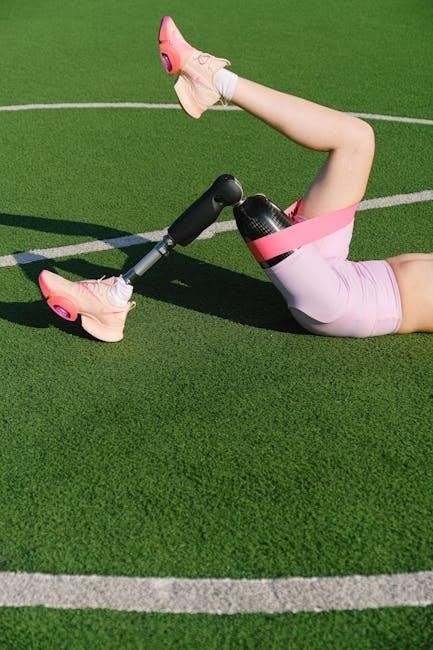
Maintain controlled movements throughout each exercise, avoiding quick or jerky motions. Focus on proper form to maximize effectiveness and minimize injury risk. Start with lighter resistance and gradually increase as you gain strength.
Be mindful of your surroundings, ensuring sufficient space to move freely. If experiencing pain, stop the exercise and consult a healthcare professional. Warming up before and cooling down after your workout is also highly recommended.

Upper Body Exercises with Elastic Bands
Strengthen your chest, back, shoulders, and arms effectively with a variety of elastic band exercises, targeting all major muscle groups.
Chest Exercises
Target your pectoral muscles with dynamic resistance using elastic bands. These exercises are excellent for building upper body strength and definition, and can be modified for various fitness levels. Bands provide constant tension throughout the movement, promoting muscle engagement and growth.
Focus on controlled movements and proper form to maximize effectiveness and prevent injury. Remember to choose a band resistance that challenges you while allowing you to maintain good technique. Incorporating chest exercises into your routine will contribute to a well-rounded and balanced physique. Bands are a portable and convenient alternative to traditional weights, making it easy to workout anywhere.
Band Chest Press
Secure the elastic band around your back, positioning it under your armpits. Grip the ends of the band with your hands, palms facing forward. Lie on your back with knees bent and feet flat on the floor. Extend your arms straight above your chest, maintaining a slight bend in your elbows.
Press the band upwards, mimicking a traditional chest press, until your arms are fully extended but not locked. Slowly return to the starting position, controlling the band’s resistance. Perform 3 sets of 10-12 repetitions. Focus on squeezing your chest muscles throughout the exercise for optimal results.
Band Chest Flyes
Anchor the elastic band securely to a stable object at chest height. Grab the ends of the band with your hands, palms facing each other. Step forward slightly to create tension in the band. Maintain a slight bend in your elbows throughout the exercise.
Keeping your core engaged, slowly open your arms out to the sides in a wide arc, feeling a stretch in your chest. Squeeze your chest muscles to bring your hands back together in front of your chest. Perform 3 sets of 10-12 repetitions, focusing on controlled movements and a full range of motion.
Back Exercises
Strengthening your back is crucial for posture, stability, and injury prevention. Elastic bands provide excellent resistance for targeting various back muscles. These exercises can be easily modified to suit different fitness levels. Remember to maintain proper form throughout each movement to maximize effectiveness and minimize risk of strain.
Focus on squeezing your shoulder blades together during pulling motions. Control the band’s resistance both during the contraction and the return phase. Incorporate both seated and standing variations for a comprehensive back workout. Consistent practice will lead to noticeable improvements in back strength and endurance.
Band Rows (Seated & Standing)
Band rows are a fantastic exercise for developing upper back strength and improving posture. For seated rows, sit with legs extended and the band looped around your feet. Pull the band towards your torso, keeping your back straight and elbows close to your body. Standing rows involve anchoring the band and performing a similar pulling motion.
Focus on squeezing your shoulder blades together as you row. Maintain a controlled tempo throughout the exercise. Adjust the band resistance to challenge yourself appropriately. Both variations effectively target the rhomboids, trapezius, and latissimus dorsi muscles, contributing to a stronger and healthier back.
Band Pull-Aparts
Band pull-aparts are excellent for strengthening the rear deltoids, rotator cuff muscles, and upper back – crucial for shoulder health and posture. Hold a resistance band with an overhand grip, arms extended in front of you at shoulder height. Keeping your arms straight (but not locked), pull the band apart, squeezing your shoulder blades together.
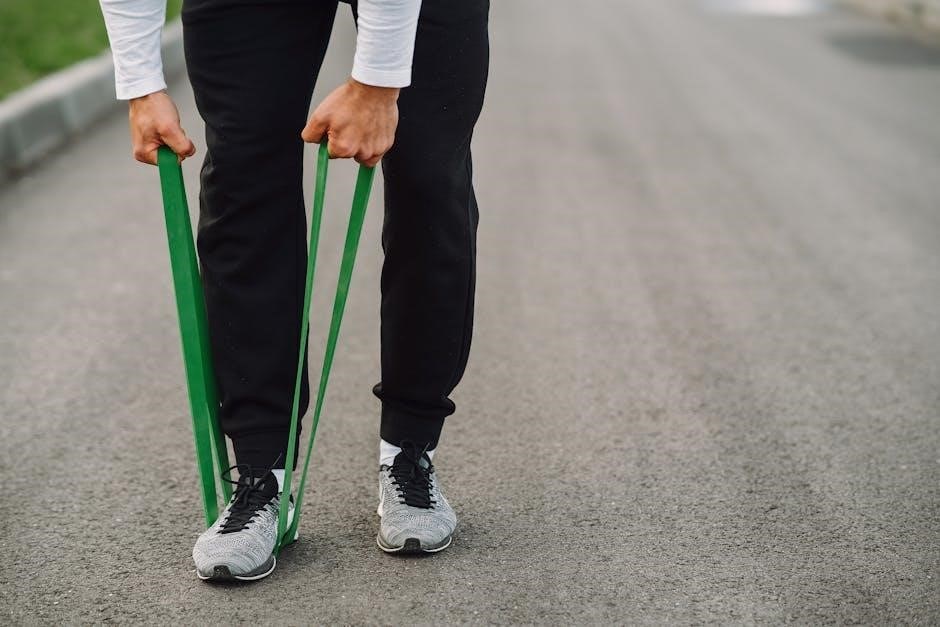
Focus on initiating the movement with your rear deltoids and maintaining control throughout. Avoid shrugging your shoulders. This exercise helps counteract the effects of prolonged sitting and forward-rounded shoulders. Choose a band resistance that allows for proper form and a full range of motion.
Shoulder Exercises
Strengthening your shoulders with elastic bands improves stability, range of motion, and overall upper body function. These exercises target the deltoids – the muscles responsible for lifting and rotating your arms. Proper form is essential to prevent injury; focus on controlled movements and engaging the correct muscle groups.
We’ll cover lateral raises, which target the medial deltoid for width, and front raises, which work the anterior deltoid. Remember to select a band resistance appropriate for your fitness level, starting lighter and gradually increasing as you get stronger. Consistent shoulder work contributes to better posture and athletic performance.
Band Lateral Raises
Band Lateral Raises effectively target the medial deltoid, contributing to broader shoulders and improved upper body aesthetics. Secure the band under your feet, holding the handles with palms facing your body. Keeping a slight bend in your elbows, raise your arms out to the sides until they reach shoulder height.

Focus on leading with your elbows and maintaining a controlled tempo. Avoid shrugging your shoulders or using momentum. Slowly lower your arms back to the starting position. Perform 3 sets of 12-15 repetitions. Choose a band resistance that challenges you while maintaining proper form throughout the exercise.
Band Front Raises
Band Front Raises primarily work the anterior (front) deltoids, enhancing shoulder strength and definition. Stand on the elastic band with feet shoulder-width apart, holding the handles with palms facing your thighs. Maintaining a slight bend in your elbows, slowly raise your arms straight out in front of you to shoulder height.
Avoid swinging your body or using momentum; focus on controlled movement. Pause briefly at the top of the movement, then slowly lower your arms back to the starting position. Aim for 3 sets of 12-15 repetitions. Select a band resistance that provides a good challenge without compromising form.
Arm Exercises
Strengthening your arms with elastic bands is incredibly effective for building definition and functional strength. These exercises target biceps, triceps, and forearms, improving your ability to perform everyday tasks. We’ll explore variations for curls and extensions, allowing you to customize your workout based on your fitness level and goals.
Remember to maintain proper form throughout each exercise, focusing on controlled movements and engaging the target muscles; Adjust band resistance as needed to ensure a challenging yet manageable workout. Consistent practice will yield noticeable improvements in arm strength and endurance.
Band Bicep Curls
Band bicep curls are a fantastic way to isolate and strengthen your biceps using elastic resistance. Secure the band under your feet, holding the handles with palms facing forward. Keeping your elbows close to your body, curl the handles upwards towards your shoulders, squeezing your biceps at the top of the movement.
Slowly lower the handles back to the starting position, maintaining tension on the band throughout the exercise. Perform 3 sets of 12-15 repetitions. To increase difficulty, use a heavier resistance band or shorten the band length. Focus on controlled movements for optimal results and to prevent injury.
Band Tricep Extensions
Band tricep extensions effectively target the back of your upper arms, building strength and definition. Secure one end of the band overhead – you can use a sturdy door anchor or have a partner hold it. Grasp the other end with one hand, keeping your elbow close to your head.
Extend your forearm upwards, straightening your arm and focusing on contracting your triceps. Slowly return to the starting position, resisting the band’s pull. Complete 3 sets of 12-15 repetitions per arm. Adjust band resistance to match your strength level. Maintain a stable core and controlled movement throughout the exercise.

Lower Body Exercises with Elastic Bands
Strengthen your legs and glutes with resistance bands, enhancing stability and power through targeted exercises for a complete lower body workout.
Leg Exercises
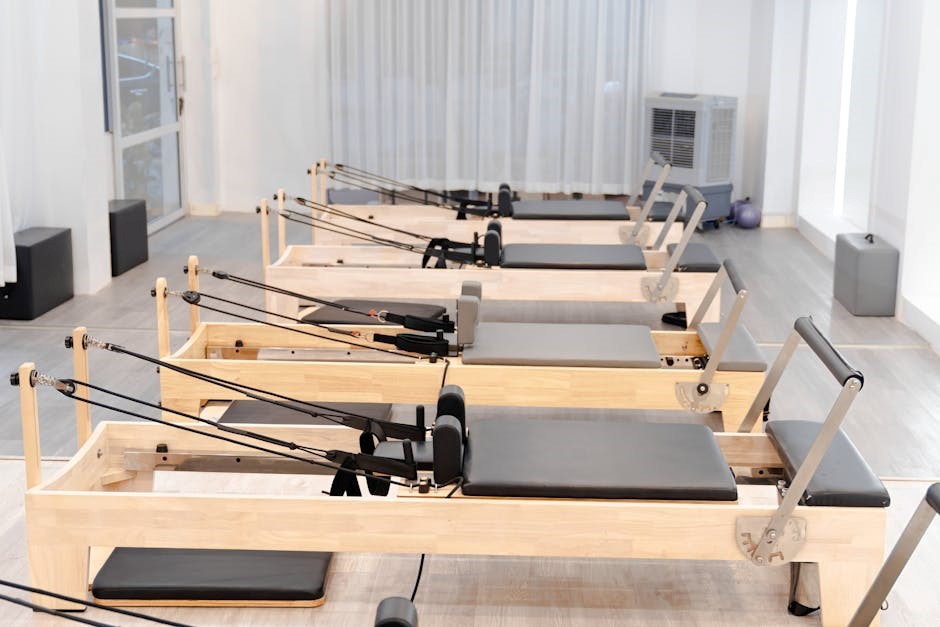
Targeting your quads, hamstrings, and calves with elastic band leg exercises is a fantastic way to build lower body strength and endurance. These exercises are incredibly adaptable, allowing you to modify the resistance by choosing different band strengths or adjusting the band placement.
Banded squats, for example, increase glute activation and challenge your stability. Placing the band just above your knees forces you to actively push outwards, engaging those often-underworked glute medius muscles. Similarly, band walks – side steps with a band around your ankles – are excellent for hip and glute strengthening.
For hamstring focus, consider hamstring curls using a band anchored securely. Remember to maintain controlled movements throughout each exercise to maximize effectiveness and minimize the risk of injury. Proper form is crucial!
Band Squats
Band squats are a phenomenal variation of the traditional squat, significantly enhancing glute activation and overall lower body strength. To perform, place a resistance band around your thighs, just above your knees; Ensure the band is snug but comfortable – it shouldn’t restrict circulation.
Stand with feet shoulder-width apart, maintaining a slight outward angle in your toes. Initiate the movement by pushing your hips back and bending your knees, as if sitting into a chair. Focus on keeping your back straight and your core engaged throughout the entire motion.
As you squat, actively push your knees outwards against the band’s resistance. This outward pressure is key to engaging your glute medius. Return to the starting position, continuing to resist the band, and repeat for desired repetitions.
Band Glute Bridges
Band glute bridges are an excellent exercise for isolating and strengthening the glutes and hamstrings. Begin by lying on your back with your knees bent and feet flat on the floor, hip-width apart; Place a resistance band around your thighs, just above your knees.
Engage your core and squeeze your glutes to lift your hips off the floor, creating a straight line from your shoulders to your knees. As you lift, actively push your knees outwards against the band, maintaining tension throughout the movement.
Hold the bridge position for a second, focusing on the glute contraction, then slowly lower your hips back down to the starting position. Repeat for the desired number of repetitions, ensuring controlled movements and consistent band tension.
Hip Exercises
Strengthening your hip muscles is crucial for stability, balance, and preventing injuries. Elastic bands provide fantastic resistance for targeting these often-underworked areas. These exercises improve functional movement patterns and enhance athletic performance.
Focus on controlled movements and maintaining proper form throughout each repetition. Bands allow for progressive overload, meaning you can easily increase the challenge as you get stronger by choosing bands with higher resistance levels.
We’ll explore exercises like band hip abductions and adductions, which specifically target the muscles responsible for moving your legs away from and towards the midline of your body, respectively. Prepare to feel the burn!
Band Hip Abductions
Band hip abductions effectively target the gluteus medius, a key muscle for hip stabilization and preventing inward knee collapse. To perform this exercise, secure a resistance band around your ankles. Stand with feet hip-width apart, maintaining a slight bend in your knees.
Keeping your back straight and core engaged, slowly lift one leg out to the side, against the band’s resistance. Focus on initiating the movement from your hip, not your lower back. Control the movement as you return your leg to the starting position.
Repeat on the other side. Aim for 15-20 repetitions per leg for 3 sets. Increase resistance as you gain strength.
Band Hip Adductions
Band hip adductions primarily work the inner thigh muscles (adductors), crucial for leg stability and movement. Begin by securing a resistance band around your ankles. Lie on your side with your legs extended and the top leg slightly bent for stability.
Keeping your body in a straight line, slowly bring your top leg towards your bottom leg, resisting the band’s pull. Focus on squeezing your inner thigh muscles during the movement. Control the return to the starting position.
Complete 15-20 repetitions per leg for 3 sets. Adjust band resistance to match your strength level. Proper form is vital to avoid strain.
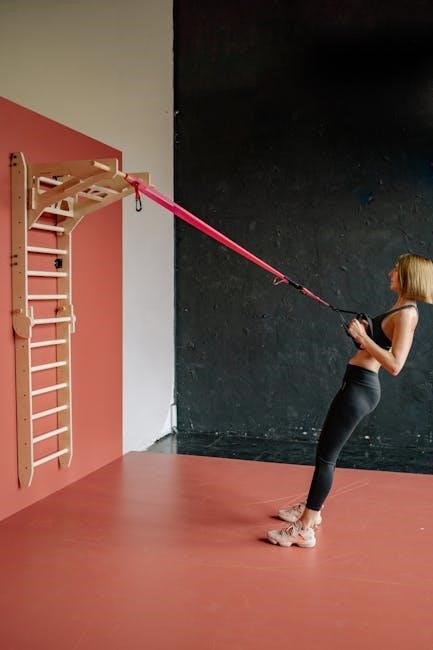
Full Body & Advanced Exercises
Challenge yourself with combined movements and increased resistance for a dynamic workout, maximizing calorie burn and building functional strength.
Combining Upper & Lower Body Movements
Integrating upper and lower body exercises with elastic bands elevates your workout’s efficiency and effectiveness. These compound movements demand greater coordination and engage more muscle groups simultaneously, mimicking real-life activities.
Consider a banded squat with an overhead press – simultaneously working your legs and shoulders. Or try a lunge with a band row, targeting your quads, glutes, and back.
These combinations not only save time but also boost your metabolic rate, leading to increased calorie expenditure. Remember to maintain proper form throughout each exercise to prevent injuries and maximize results. Focus on controlled movements and a stable core for optimal performance.
Progressive Overload with Elastic Bands
Progressive overload is crucial for continuous improvement in any fitness regimen, and elastic bands are no exception. As you get stronger, simply using the same band resistance will yield diminishing returns. To challenge your muscles, gradually increase the resistance.
This can be achieved by switching to a heavier band, doubling up bands for increased tension, or increasing the number of repetitions and sets.
Another method is to slow down the tempo of your movements, increasing time under tension. Consistent progressive overload ensures your muscles are continually challenged, promoting strength gains and preventing plateaus. Track your progress to stay motivated and adjust accordingly.

Resources & Further Learning
Explore numerous online resources, including downloadable elastic band exercise PDFs and video tutorials, to expand your knowledge and workout routines.
Recommended Elastic Band Brands
Choosing quality bands is crucial for safety and effectiveness. Several brands consistently receive high ratings from fitness professionals and users alike. TheraBand is a widely recognized name, offering a comprehensive range of resistances and often featured in rehabilitation settings and elastic band exercise PDFs.
Fit Simplify provides excellent value with their set of five bands, ideal for home workouts and easily found alongside free workout guides. Bodylastics stands out with its stackable band system, allowing for highly customized resistance levels – perfect for progressive overload.
Serious Steel Fitness caters to more advanced users, offering durable and heavy-duty bands. Finally, WODFitters provides eco-friendly latex bands with a focus on sustainability. Remember to check reviews and consider your fitness level when selecting a brand.
Finding Elastic Band Workout PDFs & Videos
Numerous resources are available online to guide your elastic band training. A simple Google search for “elastic band exercises PDF” yields a wealth of free workout plans, categorized by muscle group or fitness level. Websites like Fitwirr and Blogilates offer detailed PDFs with visual demonstrations.
YouTube is a fantastic platform for video tutorials. Channels such as “POPSUGAR Fitness” and “HASfit” provide comprehensive routines led by certified trainers. Pinterest also serves as a visual discovery engine, linking to various workout plans and infographics.
Don’t forget to explore fitness app stores; many apps include band-specific workouts. Always prioritize proper form and listen to your body when following any online resource.