Blind wine tasting sheets, often available as PDF downloads, are essential tools for evaluating wines objectively. They aid in deductive reasoning, identifying grape varietals, and pinpointing origins.
What is a Blind Wine Tasting?
A blind wine tasting is a sensory evaluation where the wine’s identity – grape varietal, origin, and vintage – is concealed from the taster. This practice eliminates preconceived notions and biases that can influence perception. Utilizing a wine tasting sheet, often a downloadable PDF, becomes crucial for systematic assessment.
The goal isn’t simply to enjoy the wine, but to analyze it objectively, relying solely on appearance, aroma, and palate characteristics. Sommeliers employ this method during training, mirroring the structure of a deductive grid template. It’s a fantastic way for enthusiasts to hone their skills, recognizing nuances and developing a deeper understanding of wine. The process encourages focused observation and detailed note-taking, enhancing the overall tasting experience.
The Purpose of a Tasting Sheet
A wine tasting sheet, frequently found as a printable PDF, serves as a structured framework for evaluating wine. It moves beyond simple enjoyment, prompting detailed analysis of key characteristics. These sheets, similar to those used by sommeliers, facilitate a deductive approach to identifying a wine’s grape, country, region, and even vintage.
The sheet’s organized format encourages consistent assessment, minimizing subjective impressions. Whether at a formal tasting, a winery visit, or a casual dinner, it provides a record of observations. Using a scorecard template allows for comparison between wines and tracks personal preferences. Ultimately, a tasting sheet enhances learning and refines one’s palate.

Key Components of a Wine Tasting Sheet
Essential elements on a PDF wine tasting sheet include sections for appearance, aroma, palate, and deduction – guiding objective evaluation of each wine sampled.
Appearance Evaluation
The appearance section of a PDF wine tasting sheet begins with assessing color and clarity. Note the hue – is it pale straw, deep ruby, or something else? Clarity indicates whether the wine is brilliant, clear, hazy, or cloudy.
Next, evaluate “legs” or “tears.” After swirling, observe the droplets that form on the glass sides. Thicker, slower-moving legs often suggest higher alcohol content or residual sugar, though this isn’t a definitive indicator of quality.
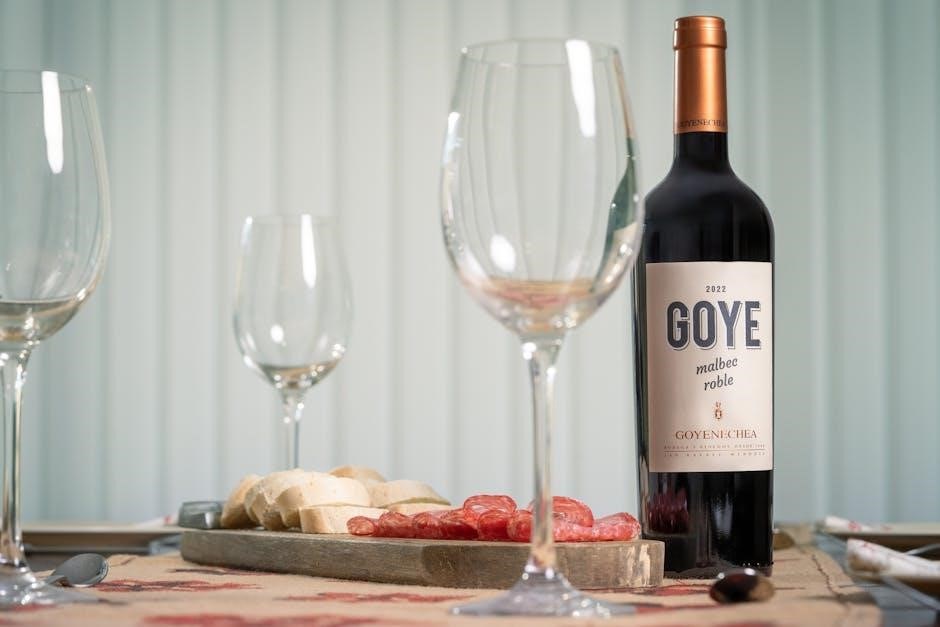
Documenting these visual cues provides initial clues about the wine’s age, concentration, and potential style, setting the stage for aroma and palate assessment. A well-designed PDF sheet will have dedicated spaces for these observations.
Color & Clarity
A PDF wine tasting sheet’s color & clarity section is fundamental. Begin by meticulously noting the wine’s hue – is it a pale lemon, golden yellow, ruby red, or a deep garnet? Consider the intensity; is it light, medium, or dark?
Clarity is equally crucial. Is the wine brilliantly clear, simply clear, slightly hazy, or completely cloudy? Haze can indicate instability or unfiltered status. These observations, recorded on your PDF sheet, offer initial insights into the wine’s age, grape variety, and winemaking techniques.
Accurate color and clarity assessment forms a vital first impression before moving onto aroma and taste.
Legs/Tears
The “legs” or “tears” observed on a wine glass, documented on your PDF tasting sheet, provide clues about alcohol content and glycerol levels. After swirling, note the viscosity of the streaks running down the glass. Are they thick and slow-moving, or thin and quick?
While often misinterpreted as indicating quality, prominent legs generally suggest higher alcohol or residual sugar. However, this isn’t a definitive indicator of a superior wine.
Record your observations – fast, medium, or slow – on the PDF sheet. This detail, combined with other sensory evaluations, contributes to a more comprehensive understanding of the wine’s composition.
Aroma Evaluation
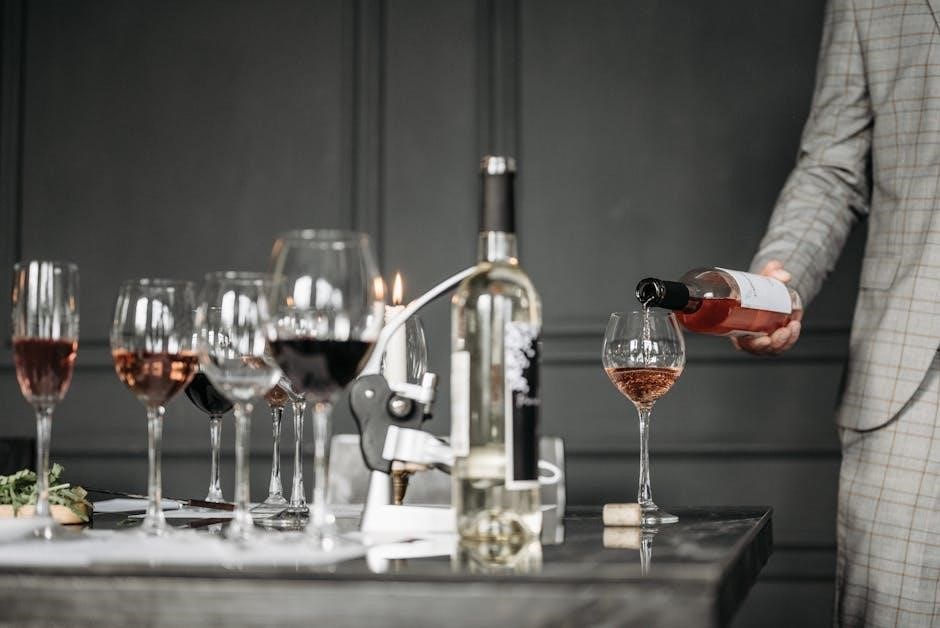
The aroma is a crucial component of blind wine tasting, meticulously recorded on your PDF tasting sheet. Begin by assessing the intensity – is it faint, moderate, or pronounced? Then, identify specific aroma characteristics.
Categorize scents into families: fruit (citrus, red fruit, black fruit), floral (rose, violet, honeysuckle), spice (pepper, clove, vanilla), and others (earth, herbal, mineral).
Be as descriptive as possible on your PDF sheet; instead of “fruit,” specify “black cherry” or “raspberry.” Accurate aroma identification is key to deducing grape varietal and origin.
Intensity of Aromas
When utilizing a blind wine tasting sheet PDF, evaluating aroma intensity is the initial step. This assessment gauges how readily the aromas present themselves. Typically, intensity is categorized on a scale.
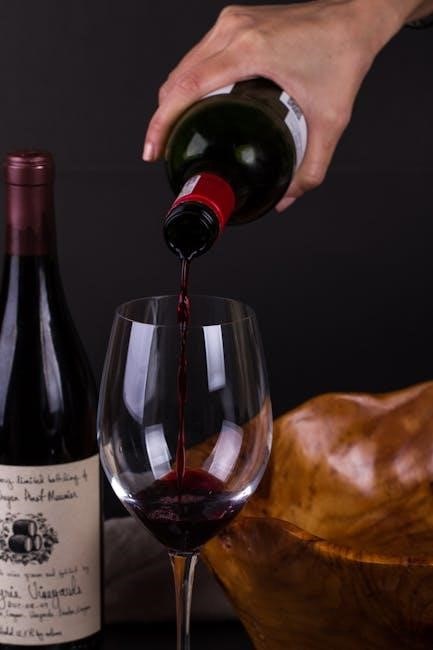
Common descriptors include: faint (subtle, requiring effort to detect), moderate (noticeable, but not overpowering), and pronounced (immediately apparent, strong).
Record your observation clearly on the PDF. A pronounced aroma suggests a potentially higher-quality wine or a more aromatic grape varietal. Conversely, a faint aroma might indicate a young wine or one lacking complexity. Accurate intensity assessment guides further aroma identification.
Aroma Characteristics (Fruit, Floral, Spice, etc.)
A crucial section of any blind wine tasting sheet PDF focuses on identifying specific aroma characteristics. Beyond intensity, detail what you smell. Categorize aromas into broad families: fruit (red, black, citrus, stone), floral (rose, violet, honeysuckle), spice (pepper, clove, cinnamon), and others (earth, herbal, oak).
Be as precise as possible – “black cherry” is more helpful than simply “fruit.”
This detailed description, recorded on your PDF, forms the foundation for deducing the grape varietal and origin. Recognizing these nuances requires practice, but a well-structured sheet guides your analysis, improving your tasting skills.
Palate Evaluation
The “Palate Evaluation” section of a blind wine tasting sheet PDF moves beyond aromas to assess the wine’s structure and flavors. This involves evaluating key components like dryness/sweetness, acidity, tannins (primarily in red wines), and body – categorized as light, medium, or full.
Record your impressions of each element. Is the acidity bracing or mellow? Are the tannins smooth or astringent?
Crucially, note the dominant flavor characteristics, mirroring the aroma section. A comprehensive PDF sheet provides space to detail these sensations, forming a holistic picture of the wine’s profile.
Dryness/Sweetness
The “Dryness/Sweetness” section on a blind wine tasting sheet PDF assesses the residual sugar level in the wine. This isn’t about perceived fruitiness, but the actual amount of sugar remaining after fermentation. A PDF template will typically offer a scale – from bone dry to very sweet – to guide your assessment.
Consider if the wine feels crisp and lacking sweetness, or if there’s a noticeable sugary sensation. Even wines with fruit-forward aromas can be technically dry. Accurate evaluation here is vital for varietal and regional deduction, as sweetness levels vary greatly.
Acidity
Evaluating “Acidity” on a blind wine tasting sheet PDF is crucial, as it significantly impacts a wine’s structure and aging potential. A good PDF template will prompt you to assess the wine’s tartness or freshness. Is it mouthwatering and vibrant, or flat and lacking lift?
High acidity wines feel crisp and lively, while low acidity wines can seem flabby. Consider how the acidity interacts with other elements like sweetness and tannins. Acidity is a key indicator of grape growing region; cooler climates generally produce higher acidity wines. Accurate assessment aids in deductive reasoning.
Tannins (for Red Wines)
When utilizing a blind wine tasting sheet PDF for red wines, assessing “Tannins” is paramount. These compounds, found in grape skins, seeds, and stems, create a drying sensation in the mouth. A well-designed PDF will guide you to evaluate tannin levels: are they harsh, smooth, or silky?
Consider the tannin quality – are they fine-grained or coarse? High tannins contribute to structure and aging potential, while low tannins result in a softer mouthfeel. Tannin levels often indicate grape varietal and winemaking techniques. Accurate tannin assessment is vital for deductive reasoning and wine identification.
Body (Light, Medium, Full)
A comprehensive blind wine tasting sheet PDF includes evaluating a wine’s “Body,” referring to its weight and fullness in the mouth. This isn’t about alcohol content, but the overall tactile sensation. Light-bodied wines feel thin, like water, while full-bodied wines are richer and more viscous.
The PDF should prompt you to categorize the wine as light, medium, or full. Body is influenced by alcohol, glycerol, and extract levels. It’s a crucial element for deduction, helping narrow down grape varietals – Pinot Noir is typically light, Cabernet Sauvignon full. Accurate body assessment enhances your tasting skills.
Flavor Characteristics
A detailed blind wine tasting sheet PDF dedicates significant space to “Flavor Characteristics.” Beyond simply naming flavors, it encourages specific descriptions. Think beyond “fruit” – is it red cherry, blackcurrant, or plum? Is there citrus, or tropical fruit?
The PDF should prompt you to identify primary (grape-derived), secondary (winemaking-derived – vanilla, butter), and tertiary (aging-derived – leather, tobacco) flavors. Detailed notes are vital for deduction. Recognizing specific flavor profiles helps pinpoint grape varietals and regions. A well-structured sheet facilitates a systematic approach to flavor identification, improving your analytical skills.
Deduction & Identification
A comprehensive blind wine tasting sheet PDF guides you through deductive reasoning. After assessing appearance, aroma, and palate, the sheet prompts guesses regarding grape varietal, country, and region. This isn’t about being correct initially; it’s about building a logical argument based on your observations.
The PDF often includes space to justify your guesses – linking specific characteristics to potential origins. For example, high acidity and citrus notes might suggest a cool-climate region. Utilizing a structured sheet, like a sommelier’s training tool, enhances your ability to systematically analyze and identify wines, improving your palate memory.
Grape Varietal Guess
The blind wine tasting sheet PDF dedicates a specific section for your grape varietal guess. Based on aroma profiles – fruit, floral, spice – and palate characteristics like tannins and acidity, you’ll formulate a hypothesis. Is it a Cabernet Sauvignon with blackcurrant notes, or a Pinot Noir exhibiting cherry and earthy tones?
Don’t hesitate to list multiple possibilities, ranking them by confidence. A well-designed PDF encourages noting why you suspect a particular varietal. This analytical process, crucial for sommelier training, strengthens your ability to connect sensory input to specific grape types, refining your palate over time.
Country of Origin Guess
A key component of any blind wine tasting sheet PDF is the section dedicated to guessing the country of origin. Consider climate influences – Old World versus New World – and typical regional characteristics. Does the wine’s structure and fruit profile suggest France, Italy, or perhaps a warmer climate like Australia or California?
The PDF should provide space to justify your reasoning. Note any clues from the aroma and palate, such as earthy notes hinting at Europe or bolder fruit suggesting the Americas. Accurate deduction relies on linking sensory details to geographical wine-making traditions, enhancing your understanding of global wine styles.
Region Guess
Following the country of origin, a detailed blind wine tasting sheet PDF prompts a region-specific guess. This requires a deeper understanding of terroir and microclimates. For example, within France, could it be Burgundy, Bordeaux, or the Rhône Valley? Consider the typical grape varietals grown in each region.
The PDF should encourage detailed notes. Does the wine exhibit the minerality often found in Chablis, or the herbaceous notes characteristic of certain Bordeaux blends? Refining your regional guesses strengthens your deductive skills and demonstrates a nuanced appreciation for wine’s geographical influences.
Scoring Systems & Ratings
A comprehensive blind wine tasting sheet PDF often incorporates scoring systems for objective evaluation. Point-based systems, like the 100-point scale, are common, assessing various attributes. Alternatively, descriptive rating scales use terms like “exceptional,” “good,” or “fair” for each characteristic.
These systems provide a structured way to quantify impressions. The PDF might include sections for overall quality, balance, and length of finish. Consistent scoring refines palate calibration and allows for comparative analysis between wines. Utilizing a standardized system, found within the PDF template, enhances the tasting experience and provides valuable feedback.
Point-Based Systems
Many blind wine tasting sheet PDFs utilize point-based systems, most notably the 100-point scale, for structured assessment. This method assigns numerical values to aspects like aroma, palate, and overall impression. A detailed PDF template will often break down point allocations – for example, 30 points for aroma intensity and complexity, 40 for palate characteristics, and 30 for overall balance and finish.
This quantifiable approach facilitates comparison between wines and provides a clear, concise rating. The PDF allows tasters to objectively record scores, aiding in developing a consistent evaluation framework. Such systems, readily available in PDF format, are favored by professionals and enthusiasts alike.
Descriptive Rating Scales
Alongside point systems, blind wine tasting sheet PDFs frequently incorporate descriptive rating scales. Instead of numbers, these utilize qualitative terms like “light-bodied,” “medium acidity,” or “complex aromas.” A well-designed PDF template provides a range of descriptors for each characteristic, allowing for nuanced evaluation.
These scales encourage detailed observation and articulate tasting notes beyond simple scores. Many PDF resources offer scales for tannin levels, sweetness, and flavor intensity. This approach is particularly useful for beginners, fostering a deeper understanding of wine attributes. Utilizing these scales within a PDF format promotes consistent and informative tasting experiences.
Finding & Using PDF Templates
Numerous free wine tasting sheet PDF templates are readily available online, like those found on Pinterest, simplifying the process of evaluating wines during blind tastings.
Free Printable Wine Tasting Sheet PDFs
Fortunately, accessing free printable wine tasting sheet PDFs is remarkably easy! A quick online search reveals a wealth of options, catering to various levels of wine expertise. Platforms like Pinterest host numerous scorecards, though some may require slight adjustments to perfectly suit individual preferences.
These downloadable sheets are incredibly useful for both casual wine enthusiasts and those actively honing their palates. They provide a structured framework for assessing wines during blind tastings, encouraging systematic evaluation of key characteristics. Utilizing these resources eliminates the need for creating a sheet from scratch, saving valuable time and effort. Many templates are designed to mimic those used by sommeliers during professional training, offering a glimpse into their analytical process.
Customizing Your Own Sheet
While numerous free printable wine tasting sheet PDFs exist, tailoring a sheet to your specific needs can significantly enhance the tasting experience. Consider what aspects are most crucial to your evaluation process. Perhaps you prioritize specific aroma descriptors, or prefer a different scoring system.
Don’t hesitate to modify existing templates or create one entirely from scratch. Adding sections for personal notes, food pairing suggestions, or even space to record the taster’s emotional response can elevate the sheet’s utility. A personalized sheet becomes a valuable tool for tracking preferences and refining your palate over time, making each blind tasting more insightful.
Digital vs. Paper Sheets
The choice between digital wine tasting sheet PDFs and traditional paper versions depends on personal preference and tasting environment. Paper sheets offer a tactile experience and eliminate reliance on technology, ideal for relaxed settings. However, digital options provide advantages like easy data storage, searchability, and the ability to quickly share results.
Many apps and spreadsheet programs allow for customized wine tasting templates. Digital formats also facilitate statistical analysis of tasting notes over time. Ultimately, both methods achieve the same goal: structured evaluation. Consider portability, data management needs, and your comfort level when selecting the best format for your blind tastings.
Advanced Techniques for Blind Tasting
Utilizing a detailed blind wine tasting sheet PDF alongside the deductive tasting method sharpens analytical skills, enabling precise varietal, origin, and quality assessments.
The Deductive Tasting Method
The deductive tasting method, greatly enhanced by a comprehensive blind wine tasting sheet PDF, is a systematic approach used by sommeliers and enthusiasts alike. It begins with assessing the wine’s appearance – color and clarity – then moves to aroma evaluation, noting intensity and characteristics like fruit, floral, or spice notes.
Palate evaluation follows, focusing on dryness/sweetness, acidity, tannins (in reds), body, and dominant flavors. A well-designed PDF sheet provides structured space for these observations. Crucially, this isn’t just about listing flavors; it’s about building a logical argument.
Based on these observations, you deduce the grape varietal, country, and region. The PDF sheet acts as a framework, guiding your thought process and ensuring no crucial element is overlooked. It transforms tasting from subjective enjoyment into an objective, analytical exercise.
Using the Sheet for Training
A blind wine tasting sheet PDF is an invaluable training tool for developing your palate and deductive skills. Regularly practicing with these sheets, especially in group blind tastings, accelerates learning. The structured format forces focused observation, moving beyond simply liking or disliking a wine.
By consistently documenting your impressions – appearance, aroma, palate – and comparing your guesses to the actual wine, you refine your ability to identify key characteristics. The PDF’s sections encourage a systematic approach, mirroring the methods used by professional sommeliers.
Furthermore, using a sheet during training helps build a ‘flavor library’ – a mental catalog of aromas and tastes associated with different varietals and regions. This repeated practice, guided by the PDF, is key to mastering blind tasting.